Google Ads or SEO: how to choose with a limited budget
Google Ads and SEO on a limited budget: compare objectives, costs and website readiness without promising customers or search positions.

On a limited budget, Google Ads can be an option for testing demand through paid advertising. SEO aims to improve a website's organic presence without buying every click. The choice depends on the objective, the capacity to follow through and the condition of the page receiving those visits. Neither channel guarantees customers, and an approved campaign is not the same as enquiries received.
How each channel works
| Google search ads | SEO | |
|---|---|---|
| How a business appears | Ads subject to review and serving conditions | Organic results, with no guaranteed place |
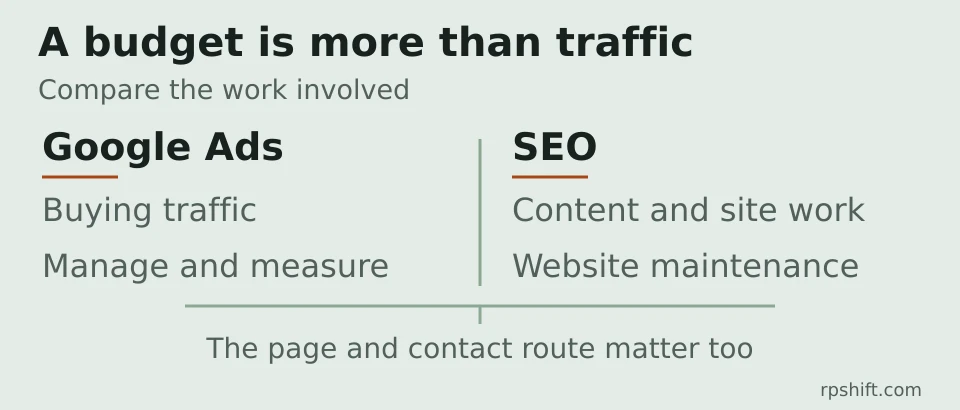
| Cost model | Paid traffic, plus management and measurement work | Content and website work, even without paying for each visit |
| Control | Budget, targeting and campaigns can be adjusted | Website changes, without direct control over search position |
| When the work stops | A paused campaign stops serving those ads | Pages may remain available; their visibility can change |
This comparison concerns search ads, not every Google Ads format. In Google's explanation of SEO and PPC, advertising gives a business the chance to appear alongside relevant searches. It does not buy a better organic position.
Ads go through review. Google says most reviews are completed within one business day, although some take longer. That describes the ad review process, not the time needed to win customers.
The effects of SEO changes vary too. Google's starter guide describes changes that may take effect within hours and others that can take several months. It also makes clear that inclusion in search results is not guaranteed. Appearing, receiving visits and receiving useful enquiries are three different outcomes.
How to choose on a small budget
Start by defining what the investment should help to test. Receiving enquiries for a local service is a different objective from making a new offer easier to find.
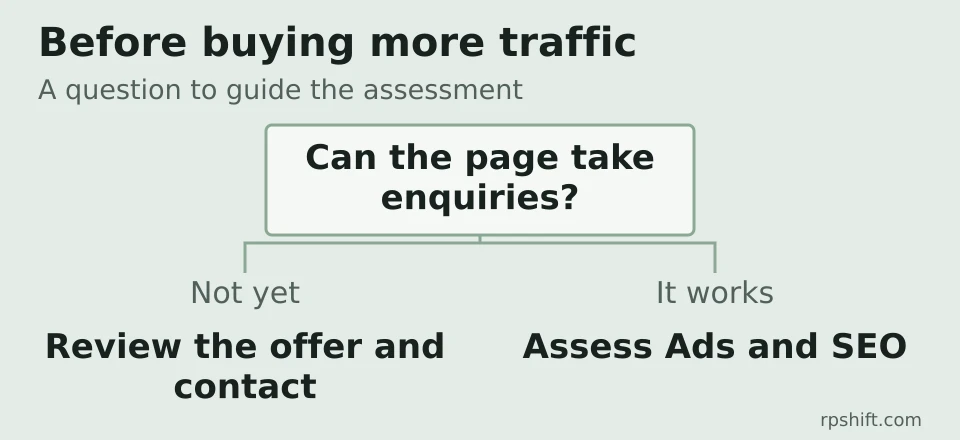
When testing demand in the short term matters, a paid campaign with a narrow scope may make sense. Its destination page needs to explain the service and provide a working contact route. Without that foundation, buying more visits can simply increase spending without making the underlying problem clearer.
When there is room to develop the work over time, useful content, clearer organisation and website accessibility may deserve priority. SEO is not free: it requires time or hired services, monitoring and maintenance. A published page is not guaranteed to keep the same search position indefinitely.
There is no budget split that suits every business. Rather than automatically allocating half to each channel, choose a test that fits the available resources and decide what will be observed before increasing the investment.
A first month, in a hypothetical scenario
At a hypothetical accounting firm in Coimbra, the team could first review a service page: which problems it addresses, what information is missing and how an enquiry reaches the person responsible. It could then test a campaign focused on the agreed services and area, with a defined spending limit.
Alongside that test, the team could improve relevant website content. At the end of the month, the review should examine what actually happened: ads served, visits, enquiries received and whether those enquiries were suitable. There may be few contacts or none. The exercise informs the next decision; it does not establish that Google Ads produces customers in a month or that SEO will have had no effect by then.
Running both at the same time
The channels can coexist without starting at the same scale. A small, monitored campaign may be compatible with focused website improvements, provided there is capacity to deliver and assess both.
Separate spending on paid traffic from management, content and maintenance work. Define who receives enquiries and how a relevant enquiry will be identified. Comparing only clicks or positions leaves out the quality of a visit and what happens afterwards.
Frequently asked questions about the choice
Will my ads improve my SEO? No. Google distinguishes paid ads from organic results. Spending on Google Ads does not buy a better organic position.
Can SEO be switched on and off? Not like a campaign. Pages can remain available after the work stops, but their visibility may change. Publishing content does not guarantee lasting traffic.
Does a small budget rule out any test? Not necessarily. It depends on the service, demand, the cost of the test and the capacity to monitor it. Limit spending and assess real enquiries rather than assuming any particular budget will be enough.
What if the service is local? The area served and contact information should be clear on the page and in the campaign. There is no universal allocation between paid advertising and organic presence for every local service.
Who manages the paid campaign
RPShift provides Google Ads setup and ongoing campaign management, with clients retaining ownership of their ad accounts. To assess a campaign in the context of the website and available budget, get in touch or book a call.
Further reading
- SEO vs. PPC: Understanding the Difference (Google)
- About the ad review process (Google)
- Search Engine Optimization Starter Guide (Google)